Reverse Mortgage California Guide
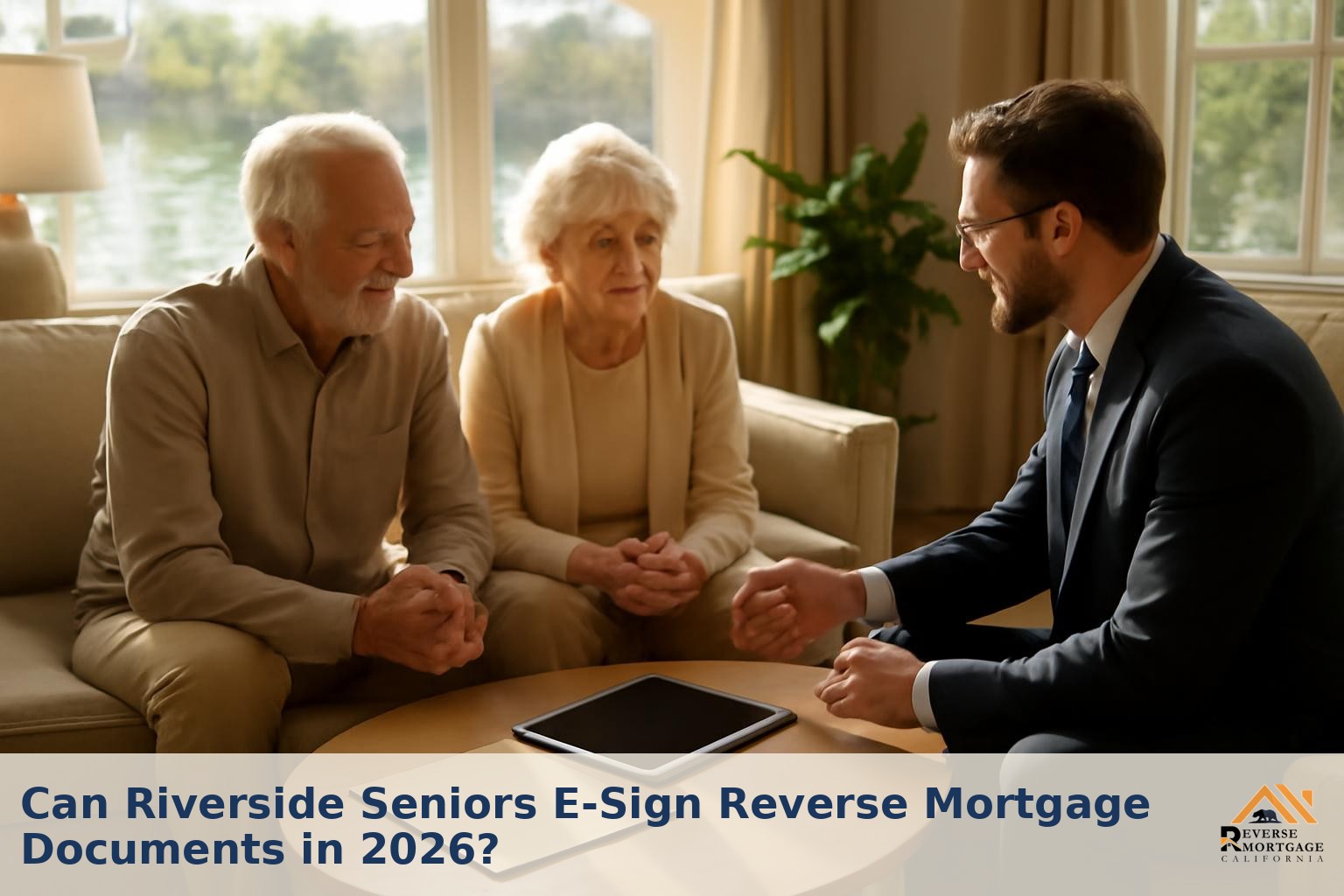
Can Riverside Seniors E-Sign Reverse Mortgage Documents in 2026?
Last updated: 2026 | Sources: HomeSafe Underwriting Manual, California reverse mortgage guidance | Author: George Kfoury, NMLS# 365129
Reverse mortgage Riverside seniors often need clear answers about electronic signature safeguards before they can decide whether a loan fits their retirement plans. This guide explains electronic signature requirements in practical terms for California homeowners as of 2026.
Riverside and Inland Empire homeowners often want a plain-language explanation before they gather documents, schedule counseling, or compare a proprietary reverse mortgage with a HECM option. The details below come from the cited HomeSafe source material and should be reviewed with a licensed professional because individual situations vary.
Introduction
Electronic signatures can simplify a reverse mortgage file, but only when the delivery method and document type satisfy the product rules. For California homeowners age 55 and older, proprietary reverse mortgage questions may arise alongside the federally insured HECM program, which generally has different age and program requirements.
The goal of this article is educational. It does not promise approval, quote loan proceeds, or replace a complete file review. It does help a Riverside family know which questions to ask before they spend time gathering paperwork.
For e-signing, convenience has limits; Riverside borrowers still need a valid personal email path, a complete audit trail, and live signatures when the document type requires them.
This guide covers 5 specific topics within safeguards, each based on the official source material and applicable to California borrowers as of 2026.
1. What must a HomeSafe e-signature audit trail show?
Answer: A HomeSafe e-signature audit trail must document borrower name and IP address, borrower consent, clear date and time stamp, and evidence of electronic signing.
Source: HomeSafe_Underwriting_Manual.pdf, Electronic Signature Requirements, page 15, current as of 2026; source date: Revised April 2026.
How this looks in practice
In practice, this rule is less about memorizing a phrase and more about knowing what the underwriter must confirm before the file can move forward.
For a Riverside homeowner, the practical step is to organize the facts before application so avoidable delays do not turn into closing problems. A homeowner should bring the issue up early, especially when family members, first-lien servicing records, insurance documents, or closing logistics may affect the answer.
Key numbers
- Revised April 2026
2. Can HomeSafe closing documents be e-signed?
Answer: HomeSafe closing documents require live signatures and cannot be e-signed.
Source: HomeSafe_Underwriting_Manual.pdf, Electronic Signature Requirements, page 16, current as of 2026; source date: Revised April 2026.
How this looks in practice
The everyday impact is that a small detail can change the next step, even when the larger reverse mortgage goal still makes sense.
For a Riverside homeowner, the practical step is to organize the facts before application so avoidable delays do not turn into closing problems. Ask for a file-specific review before assuming the requirement can be waived, substituted, or solved with a last-minute explanation.
Key numbers
- Revised April 2026
3. Can I e-sign HomeSafe documents if I do not have email?
Answer: A borrower who states they do not have an email address is ineligible for electronic signature packages.
Source: HomeSafe_Underwriting_Manual.pdf, Electronic Signature Requirements, page 15, current as of 2026; source date: Revised April 2026.
How this looks in practice
This is the kind of guideline that tends to matter before closing, not after a borrower has already invested time in the process.
For a Riverside homeowner, the practical step is to organize the facts before application so avoidable delays do not turn into closing problems. Clear documentation helps everyone separate a correctable condition from a rule that makes the product unavailable.
Key numbers
- Revised April 2026
4. Can someone else’s email be used for my HomeSafe e-signature package?
Answer: A HomeSafe borrower cannot use an email address that belongs or appears to belong to someone else for e-signature delivery.
Source: HomeSafe_Underwriting_Manual.pdf, Electronic Signature Requirements, page 15, current as of 2026; source date: Revised April 2026.
How this looks in practice
For families comparing options, the safest reading is to treat the rule as an underwriting checkpoint rather than a casual preference.
For a Riverside homeowner, the practical step is to organize the facts before application so avoidable delays do not turn into closing problems. That approach keeps the conversation focused on eligibility, timing, and whether another reverse mortgage structure should be discussed.
The main caution is straightforward: Using another person’s email can invalidate the e-signature process. That is why this topic should be raised before a senior homeowner assumes the file is ready for approval.
Key numbers
- Revised April 2026
5. Can notarized HomeSafe documents be e-signed?
Answer: Electronic signatures are not acceptable on any HomeSafe document requiring notarization.
Source: HomeSafe_Underwriting_Manual.pdf, Electronic Signature Requirements, page 16, current as of 2026; source date: Revised April 2026.
How this looks in practice
The practical takeaway is to verify the requirement against the actual loan file instead of relying on a neighbor story or a general internet summary.
For a Riverside homeowner, the practical step is to organize the facts before application so avoidable delays do not turn into closing problems. A California-specific conversation is useful because state law, property facts, and product overlays can all affect the path forward.
Key numbers
- Revised April 2026
Frequently Asked Questions
What must a HomeSafe e-signature audit trail show?
A HomeSafe e-signature audit trail must document borrower name and IP address, borrower consent, clear date and time stamp, and evidence of electronic signing. Source: HomeSafe_Underwriting_Manual.pdf, Electronic Signature Requirements, page 15, current as of 2026.
Can HomeSafe closing documents be e-signed?
HomeSafe closing documents require live signatures and cannot be e-signed. Source: HomeSafe_Underwriting_Manual.pdf, Electronic Signature Requirements, page 16, current as of 2026.
Can I e-sign HomeSafe documents if I do not have email?
A borrower who states they do not have an email address is ineligible for electronic signature packages. Source: HomeSafe_Underwriting_Manual.pdf, Electronic Signature Requirements, page 15, current as of 2026.
Can someone else’s email be used for my HomeSafe e-signature package?
A HomeSafe borrower cannot use an email address that belongs or appears to belong to someone else for e-signature delivery. Source: HomeSafe_Underwriting_Manual.pdf, Electronic Signature Requirements, page 15, current as of 2026.
Can notarized HomeSafe documents be e-signed?
Electronic signatures are not acceptable on any HomeSafe document requiring notarization. Source: HomeSafe_Underwriting_Manual.pdf, Electronic Signature Requirements, page 16, current as of 2026.
About Reverse Mortgage California
Reverse Mortgage California (NMLS# 2530594) is the consumer-facing DBA and brand of O1ne Mortgage Inc. The company helps California seniors understand reverse mortgage choices, including HECM loans that require HUD-approved counseling and proprietary options that may use separate investor guidelines.
Call or text (909) 642-8258 or visit reversemortgagecali.com.
Find us on Google for our location, hours, and directions.
About George Kfoury
George Kfoury (NMLS# 365129) has been licensed in the mortgage industry since 2003 and serves California seniors through Reverse Mortgage California with clear, practical guidance about reverse mortgage and retirement mortgage options.
He serves homeowners statewide, with strong local relevance in Los Angeles, Riverside, and the Inland Empire. Learn more about George Kfoury or call (909) 642-8258.