
HomeSafe Solar Property Guide
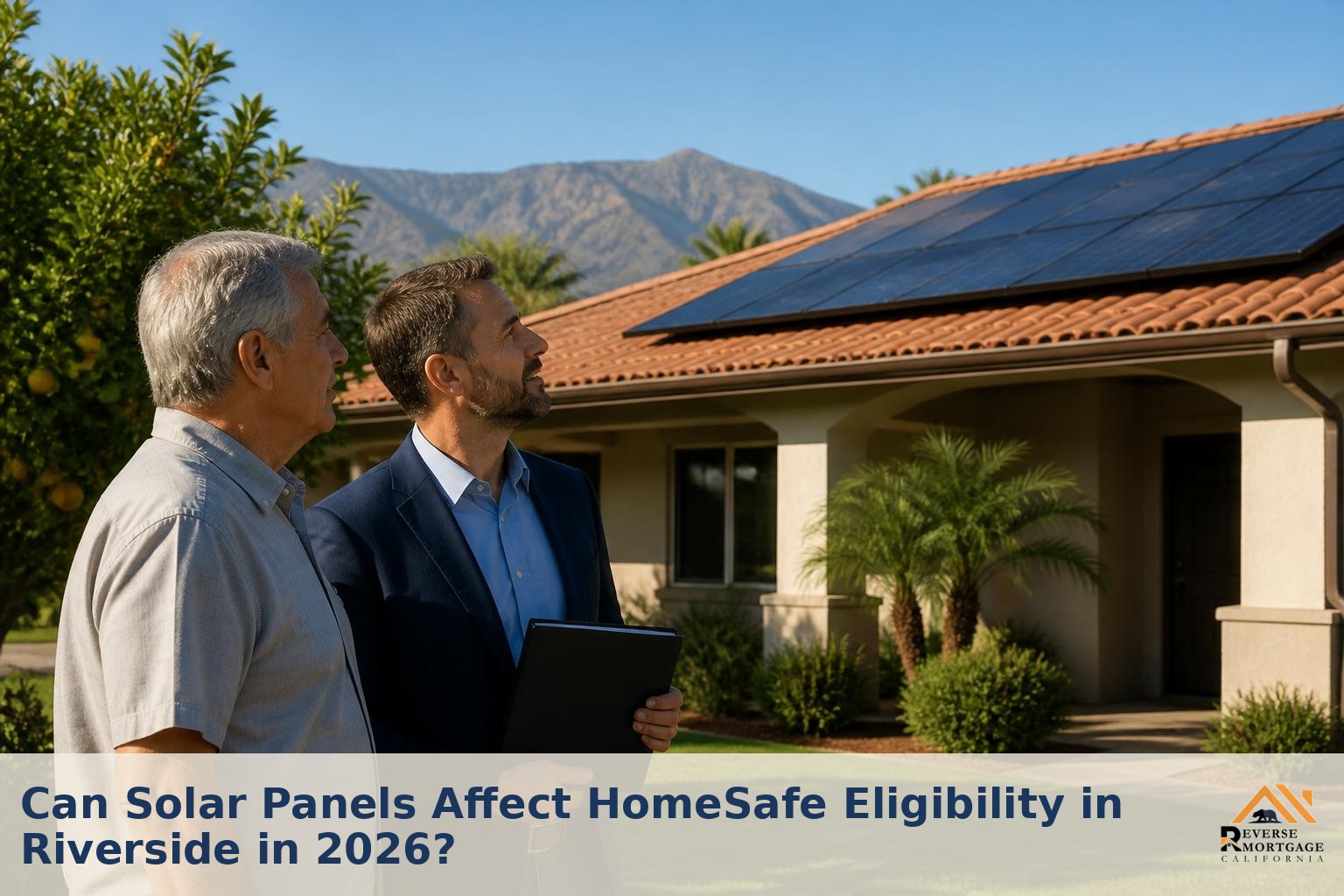
Can Solar Panels Affect HomeSafe Eligibility in Riverside in 2026?
Last updated: 2026 | Source: HomeSafe Underwriting Manual, revised April 2026 | Author: George Kfoury, NMLS# 365129
Riverside County has many homes with rooftop solar, but panels that look alike from the street can have very different legal and financial arrangements. One homeowner may own the system outright, another may lease it, and a third may still owe a solar creditor whose filing appears in a title search. HomeSafe review focuses on those documents rather than the visual presence of the equipment alone.
Introduction
HomeSafe is proprietary and is not insured by FHA like a Home Equity Conversion Mortgage. The guidelines summarized here were revised in April 2026, and future program changes are possible. Eligibility, value, proceeds, payoff handling, and closing conditions require review of the current manual and the homeowner’s full contract package.
This Riverside guide explains five connected questions about appraised value, ownership, transfer restrictions, and UCC records. Reading the rules together helps a homeowner see why a solar agreement can influence both the property analysis and the mechanics of clearing title for closing.
For Riverside readers studying HomeSafe solar agreements and liens, each answer below pairs the manual language with a realistic preparation step and a concise list of key numbers. In this Riverside HomeSafe solar agreements and liens guide, the examples are illustrations rather than underwriting decisions, and homeowners should not change a mortgage, solar agreement, title arrangement, or insurance position without appropriate professional advice.
1. Do leased solar panels count in HomeSafe value?
Answer: For a Riverside file, the governing point is that a HomeSafe appraiser must not include the value of leased solar mechanical systems or components in the property’s market value.
For Riverside section 1, Leased equipment belongs to another party, so the appraiser cannot treat those mechanical components as part of the borrower’s real-property value under the cited rule. For Riverside question 1, the solar installation may still affect marketability or require contract review, but a monthly lease payment does not convert third-party equipment into homeowner-owned collateral.
Source for HomeSafe solar agreements and liens question 1 in Riverside: HomeSafe_Underwriting_Manual.pdf, Solar – Leases, Liens, and Power Purchase Agreements, page 133, Revised April 2026; this citation supports the factual answer presented here.
How this looks in practice
In the Riverside example for question 1, A homeowner can provide the complete lease, recent statement, and any amendments before the appraisal review is finalized. For Riverside question 1, that package helps distinguish leased components from improvements the owner paid for directly and prevents an informal solar-sales description from being used as proof of ownership.
Key numbers
- 0 leased-system value added by the appraiser
- Manual page 133
- Manual revised April 2026 for Riverside question 1
2. Can solar panels add value for HomeSafe?
Answer: In Riverside planning, the manual states that a HomeSafe appraiser may include the value of a solar system only when the borrower owns it in full and it is legally part of the property.
For Riverside section 2, Ownership changes the analysis because equipment owned free and clear may be treated as part of the property when it is legally attached to the real estate. For Riverside question 2, the appraiser still determines contributory value from market evidence, so ownership permits consideration but does not guarantee a dollar-for-dollar increase based on installation cost.
Source for HomeSafe solar agreements and liens question 2 in Riverside: HomeSafe_Underwriting_Manual.pdf, Solar – Leases, Liens, and Power Purchase Agreements, page 133, Revised April 2026; this citation supports the factual answer presented here.
How this looks in practice
In the Riverside example for question 2, An owner who paid off the system can gather the purchase agreement, payoff confirmation, permits, and evidence that any related filing was terminated. For Riverside question 2, those records give the appraiser and title reviewer a firmer basis for deciding whether the system is both fully owned and legally part of the property.
Key numbers
- Full borrower ownership is required for value consideration
- Manual page 133
- Manual revised April 2026 for Riverside question 2
3. When is a solar UCC-3 filed if HomeSafe pays off solar financing?
Answer: The Riverside application is reviewed under this rule: For a financed solar lien, the creditor may file the UCC-3 after HomeSafe closing once payoff funds are received, with a post-closing condition to confirm release.
For Riverside section 3, A financed solar obligation can be paid with closing funds even when the creditor records the termination afterward. For Riverside question 3, the guideline allows that sequence only with a post-closing condition confirming the UCC-3 release, so the later filing is a tracked requirement rather than an optional administrative detail.
Source for HomeSafe solar agreements and liens question 3 in Riverside: HomeSafe_Underwriting_Manual.pdf, Solar – Leases, Liens, and Power Purchase Agreements, page 134, Revised April 2026; this citation supports the factual answer presented here.
How this looks in practice
In the Riverside example for question 3, Before closing, the settlement team may obtain a payoff statement and instructions from the solar creditor. For Riverside question 3, after the funds are received, the creditor files the UCC-3, and the loan file retains a condition until acceptable evidence confirms that the financing statement has been terminated.
Key numbers
- 1 post-closing condition to confirm release
- UCC-3 may follow receipt of payoff funds
- Manual page 134 for Riverside question 3
4. Can a solar lease make a HomeSafe property ineligible?
Answer: For a Riverside homeowner, the published restriction is clear: A HomeSafe property is ineligible if a solar lease or PPA restricts transfer of the home in a way that conflicts with proprietary guidelines.
For Riverside section 4, A lease or power purchase agreement must not obstruct a later transfer in a way that conflicts with program requirements. For Riverside question 4, restrictive consent rights, credit qualifications for a successor, or other transfer barriers require close reading because an unacceptable limitation can make the property ineligible.
Source for HomeSafe solar agreements and liens question 4 in Riverside: HomeSafe_Underwriting_Manual.pdf, Solar – Leases, Liens, and Power Purchase Agreements, page 133, Revised April 2026; this citation supports the factual answer presented here.
How this looks in practice
In the Riverside example for question 4, The homeowner should obtain the signed agreement rather than relying on a salesperson’s summary or online account screen. For Riverside question 4, a reviewer can then examine assignment, sale, foreclosure, and termination clauses to determine whether the property can transfer without a prohibited restriction.
Key numbers
- 0 conflicting transfer restrictions permitted
- Manual page 133
- Manual revised April 2026 for Riverside question 4
5. What happens if a solar UCC-1 is recorded on title for HomeSafe?
Answer: The applicable Riverside takeaway is that if a UCC-1 is recorded against the HomeSafe subject property for a solar lease or PPA, a UCC-3 release is required before closing.
For Riverside section 5, A UCC-1 related to a solar lease or PPA can appear against the subject property and must be addressed before the HomeSafe transaction closes. For Riverside question 5, the required UCC-3 is the termination or release filing used to clear that recorded interest for this purpose.
Source for HomeSafe solar agreements and liens question 5 in Riverside: HomeSafe_Underwriting_Manual.pdf, Solar – Leases, Liens, and Power Purchase Agreements, page 134, Revised April 2026; this citation supports the factual answer presented here.
How this looks in practice
In the Riverside example for question 5, A preliminary title report may reveal a filing that the homeowner did not remember or believed had already been removed. For Riverside question 5, contacting the solar company or secured party early can allow time to obtain the correct release, verify recording information, and avoid a last-minute title condition.
Key numbers
- UCC-3 release required before closing
- Manual page 134
- Manual revised April 2026 for Riverside question 5
Frequently Asked Questions
Do leased solar panels count in HomeSafe value?
For Riverside HomeSafe solar agreements and liens FAQ 1, No; leased solar mechanical systems and components are excluded from the property’s market value under the cited HomeSafe appraisal rule. The supporting source for this Riverside answer 1 is HomeSafe_Underwriting_Manual.pdf, Solar – Leases, Liens, and Power Purchase Agreements, page 133, Revised April 2026. Current HomeSafe solar agreements and liens guidelines and the complete Riverside file for question 1 still govern.
Can solar panels add value for HomeSafe?
For Riverside HomeSafe solar agreements and liens FAQ 2, Owned solar may contribute to HomeSafe value when the borrower owns it in full and it is legally part of the real property, subject to appraisal analysis. The supporting source for this Riverside answer 2 is HomeSafe_Underwriting_Manual.pdf, Solar – Leases, Liens, and Power Purchase Agreements, page 133, Revised April 2026. Current HomeSafe solar agreements and liens guidelines and the complete Riverside file for question 2 still govern.
When is a solar UCC-3 filed if HomeSafe pays off solar financing?
For Riverside HomeSafe solar agreements and liens FAQ 3, When HomeSafe closing funds pay the financed solar lien, the creditor may file the UCC-3 afterward while a post-closing condition tracks proof of release. The supporting source for this Riverside answer 3 is HomeSafe_Underwriting_Manual.pdf, Solar – Leases, Liens, and Power Purchase Agreements, page 134, Revised April 2026. Current HomeSafe solar agreements and liens guidelines and the complete Riverside file for question 3 still govern.
Can a solar lease make a HomeSafe property ineligible?
For Riverside HomeSafe solar agreements and liens FAQ 4, Yes; a solar lease or PPA can make the property ineligible when its transfer restrictions conflict with HomeSafe guidelines. The supporting source for this Riverside answer 4 is HomeSafe_Underwriting_Manual.pdf, Solar – Leases, Liens, and Power Purchase Agreements, page 133, Revised April 2026. Current HomeSafe solar agreements and liens guidelines and the complete Riverside file for question 4 still govern.
What happens if a solar UCC-1 is recorded on title for HomeSafe?
For Riverside HomeSafe solar agreements and liens FAQ 5, A recorded solar-related UCC-1 requires a UCC-3 release before HomeSafe closing under the cited title rule. The supporting source for this Riverside answer 5 is HomeSafe_Underwriting_Manual.pdf, Solar – Leases, Liens, and Power Purchase Agreements, page 134, Revised April 2026. Current HomeSafe solar agreements and liens guidelines and the complete Riverside file for question 5 still govern.
About Reverse Mortgage California
For this Riverside guide to HomeSafe solar agreements and liens, Reverse Mortgage California (NMLS# 2530594) is the consumer-facing DBA and brand of O1ne Mortgage Inc. The team offers plain-language education about HomeSafe solar agreements and liens in Riverside and product-specific review without promising approval, savings, proceeds, or a particular result.
Homeowners seeking current information about HomeSafe solar agreements and liens in Riverside can discuss their goals, existing obligations, and property documents with a licensed professional. Call or text (909) 642-8258 or visit reversemortgagecali.com.
Find us on Google for our location, hours, and directions.
About George Kfoury
George Kfoury, NMLS# 365129, has been licensed since 2003 and serves California seniors, including homeowners in Riverside who want to understand HomeSafe solar agreements and liens and broader retirement mortgage choices.
His approach to HomeSafe solar agreements and liens in Riverside emphasizes current documentation, careful distinctions between proprietary HomeSafe and FHA-insured HECM options, and referrals to legal, tax, insurance, housing-counseling, or solar-contract professionals when a question falls outside mortgage guidance.