Reverse Mortgage California Guide
Electronic Signature Requirements: A Safeguards Guide for California Seniors (2026)
Last updated: 2026 | Sources: HUD HECM Handbook 4235.1, FHA program rules, California Civil Code | Author: George Kfoury, NMLS# 365129
reverse mortgage Los Angeles seniors usually need clear answers about electronic signature requirements before they can decide whether a loan fits their retirement plans. If you own a home in Los Angeles or Los Angeles County, this guide explains are e-signatures valid for homesafe documents? and the related rules that matter most as of 2026.
According to FHA guidelines, the HECM lending limit is $1,209,750 as of 2026. Los Angeles County home values remain high, with many senior-owned properties carrying substantial built-up equity as of 2026.
Introduction
The reverse mortgage program — formally known as the Home Equity Conversion Mortgage (HECM) — is a federal lending product that allows homeowners aged 62 or older to convert home equity into cash without monthly mortgage payments. As of 2026, the FHA HECM lending limit is $1,209,750.
For California homeowners, several state-specific rules layer on top of federal HUD requirements, including a mandatory 7-day cooling-off period and additional disclosure requirements under the California Reverse Mortgage Act.
This guide covers 7 specific topics within safeguards, each based on the official source material and applicable to California borrowers as of 2026.
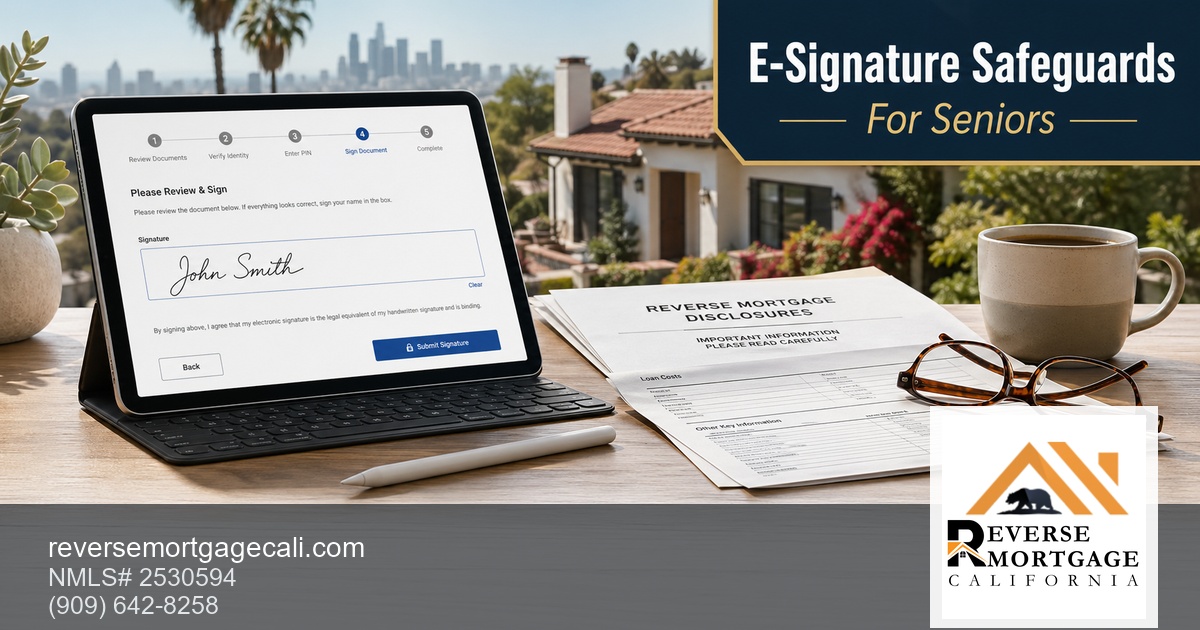
1. Are e-signatures valid for HomeSafe documents?
Answer: A valid HomeSafe e-signed document has the same validity as a wet-signed document.
Source: HomeSafe_Underwriting_Manual.pdf, Electronic Signature Requirements, page 15, current as of 2026.
How this looks in practice
A California homeowner considering a proprietary reverse mortgage should verify the exact product, state rules, property value, and underwriting requirements before relying on this rule.
2. Can someone else's email be used for my HomeSafe e-signature package?
Answer: A HomeSafe borrower cannot use an email address that belongs or appears to belong to someone else for e-signature delivery.
Source: HomeSafe_Underwriting_Manual.pdf, Electronic Signature Requirements, page 15, current as of 2026.
How this looks in practice
A California homeowner considering a proprietary reverse mortgage should verify the exact product, state rules, property value, and underwriting requirements before relying on this rule.
What to watch for
Using another person's email can invalidate the e-signature process.
3. Can spouses use a shared email for HomeSafe e-signatures?
Answer: A shared email address may be used for HomeSafe e-signatures if each applicant has independent access without third-party involvement.
Source: HomeSafe_Underwriting_Manual.pdf, Electronic Signature Requirements, page 15, current as of 2026.
How this looks in practice
A California homeowner considering a proprietary reverse mortgage should verify the exact product, state rules, property value, and underwriting requirements before relying on this rule.
4. Can I e-sign HomeSafe documents if I do not have email?
Answer: A borrower who states they do not have an email address is ineligible for electronic signature packages.
Source: HomeSafe_Underwriting_Manual.pdf, Electronic Signature Requirements, page 15, current as of 2026.
How this looks in practice
A California homeowner considering a proprietary reverse mortgage should verify the exact product, state rules, property value, and underwriting requirements before relying on this rule.
5. What must a HomeSafe e-signature audit trail show?
Answer: A HomeSafe e-signature audit trail must document borrower name and IP address, borrower consent, clear date and time stamp, and evidence of electronic signing.
Source: HomeSafe_Underwriting_Manual.pdf, Electronic Signature Requirements, page 15, current as of 2026.
How this looks in practice
A California homeowner considering a proprietary reverse mortgage should verify the exact product, state rules, property value, and underwriting requirements before relying on this rule.
6. Can HomeSafe closing documents be e-signed?
Answer: HomeSafe closing documents require live signatures and cannot be e-signed.
Source: HomeSafe_Underwriting_Manual.pdf, Electronic Signature Requirements, page 16, current as of 2026.
How this looks in practice
A California homeowner considering a proprietary reverse mortgage should verify the exact product, state rules, property value, and underwriting requirements before relying on this rule.
7. Can notarized HomeSafe documents be e-signed?
Answer: Electronic signatures are not acceptable on any HomeSafe document requiring notarization.
Source: HomeSafe_Underwriting_Manual.pdf, Electronic Signature Requirements, page 16, current as of 2026.
How this looks in practice
A California homeowner considering a proprietary reverse mortgage should verify the exact product, state rules, property value, and underwriting requirements before relying on this rule.
Frequently Asked Questions
Are e-signatures valid for HomeSafe documents?
A valid HomeSafe e-signed document has the same validity as a wet-signed document.
Can someone else's email be used for my HomeSafe e-signature package?
A HomeSafe borrower cannot use an email address that belongs or appears to belong to someone else for e-signature delivery.
Can spouses use a shared email for HomeSafe e-signatures?
A shared email address may be used for HomeSafe e-signatures if each applicant has independent access without third-party involvement.
Can I e-sign HomeSafe documents if I do not have email?
A borrower who states they do not have an email address is ineligible for electronic signature packages.
What must a HomeSafe e-signature audit trail show?
A HomeSafe e-signature audit trail must document borrower name and IP address, borrower consent, clear date and time stamp, and evidence of electronic signing.
Can HomeSafe closing documents be e-signed?
HomeSafe closing documents require live signatures and cannot be e-signed.
Can notarized HomeSafe documents be e-signed?
Electronic signatures are not acceptable on any HomeSafe document requiring notarization.
About Reverse Mortgage California
Reverse Mortgage California (NMLS# 2530594) is the consumer-facing DBA and brand of O1ne Mortgage Inc. George Kfoury (NMLS# 365129) has been licensed in the mortgage industry since 2003 and helps senior homeowners across California understand retirement mortgage options with clear, practical guidance.
Call or text (909) 642-8258 or visit reversemortgagecali.com.
About George Kfoury
George Kfoury (NMLS# 365129) has been licensed in the mortgage industry since 2003 and helps senior homeowners across California understand reverse mortgage and retirement mortgage options through Reverse Mortgage California.
He serves homeowners statewide, with strong local relevance in Los Angeles and the Inland Empire. Learn more about George Kfoury, view the Los Angeles Google Business Profile, or call (909) 642-8258.