
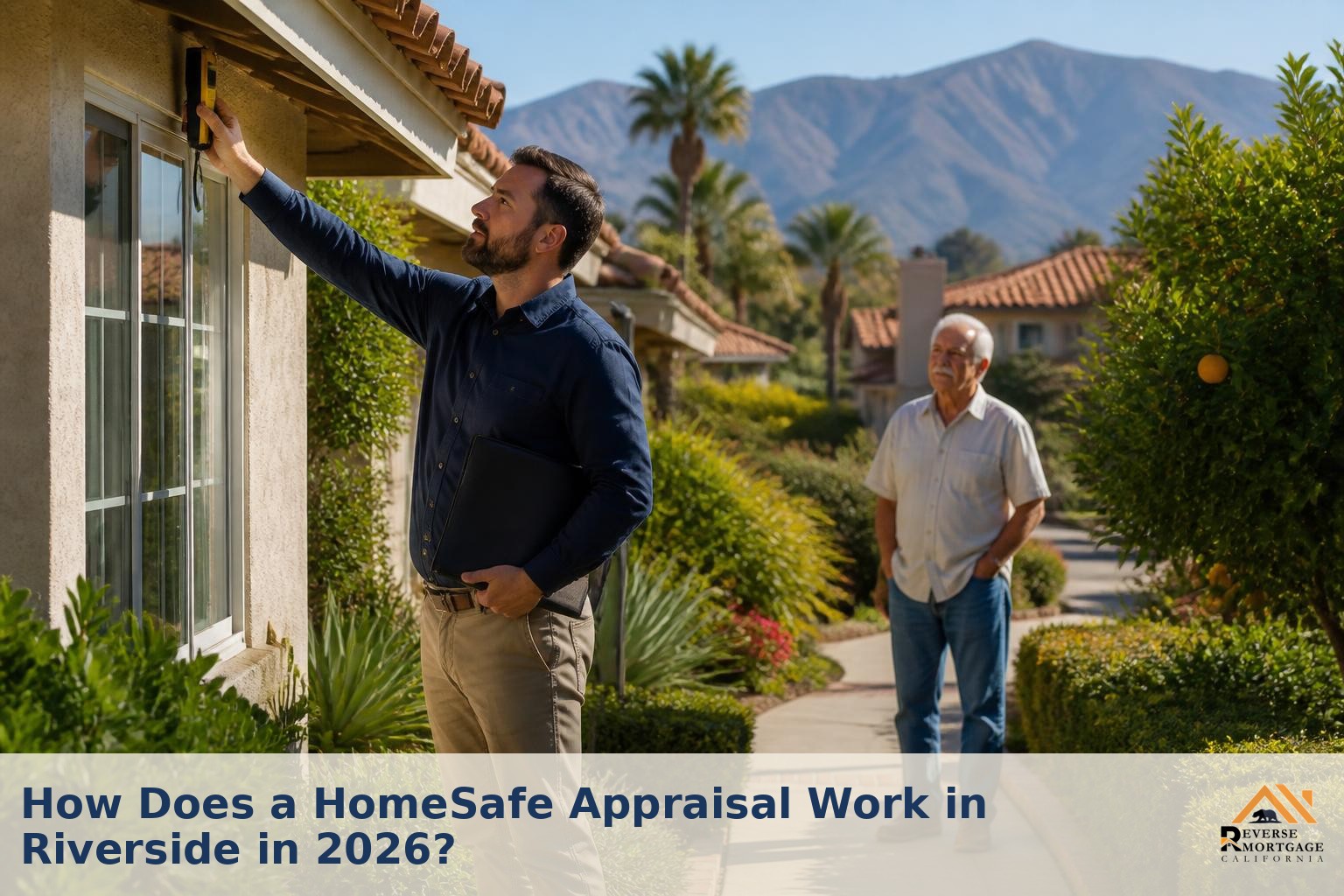
HomeSafe Appraisal Guide for Riverside
How Does a HomeSafe Appraisal Work in Riverside in 2026?
Last updated: 2026-09-30 | Source: HomeSafe Underwriting Manual, revised April 2026 | Author: George Kfoury, NMLS# 365129
An appraisal is more than a single estimate of what a home might sell for. In a HomeSafe review, comparable sales, residential use, business activity, and an independent Collateral Desktop Analysis can each affect how the lender treats the property and value.
Riverside County neighborhoods can vary by lot size, age, improvements, and mixed residential-business patterns, which makes careful comparable selection and accurate property-use reporting especially important.
Introduction
The following five points are drawn from the HomeSafe underwriting manual revised in April 2026. They explain selected program standards, not a promise of value or approval, and a licensed appraiser and current underwriter remain responsible for the file-specific conclusions.
Riverside homeowners can prepare by making the property accessible, listing permitted improvements, and separating factual records from hoped-for value. Supporting information can help an appraiser understand the home, but neither the owner nor the loan originator should pressure the appraiser toward a target.
This 2026 edition of the HomeSafe Appraisal Guide for Riverside covers five focused questions for Riverside homeowners, with each answer citing its controlling HomeSafe manual section inline and each example organizing a professional conversation without predicting approval or proceeds.
Within this HomeSafe Appraisal Guide for Riverside, remember that a proprietary reverse mortgage is not the same as an FHA-insured HECM; product availability, age requirements, rates, property standards, costs, and underwriting criteria for this subject must be confirmed for the current application, while homeowners remain responsible for taxes, insurance, maintenance, and compliance with loan terms.
1. How many comparable sales are needed for a HomeSafe appraisal?
Answer: A HomeSafe appraisal must include at least three closed comparable sales.
For a Riverside homeowner, this rule answers a narrow underwriting question: how many comparable sales are needed for a homesafe appraisal.
A HomeSafe appraisal must include at least three closed comparable sales.
For point 1 in this HomeSafe Appraisal Guide for Riverside, the guideline should be applied to the policy or loan documents actually in force, because a familiar product name may hide terms that change the result.
Source: HomeSafe_Underwriting_Manual.pdf, Appraisals, page 23, Revised April 2026.
How this looks in practice
Expect the report to identify at least three closed sales and explain adjustments; active listings may provide context, but they do not replace the cited minimum of completed transactions.
For question 1 in the HomeSafe Appraisal Guide for Riverside, the homeowner can ask the loan professional to identify the exact document, calculation, or policy term used to reach the conclusion, creating a record for this point that can address a missing item without confusing the standard with a final credit decision.
Key numbers
- The appraisal must contain at least three closed comparable sales.
- Manual edition cited: Revised April 2026.
2. Can business rental income from my home count for HomeSafe?
Answer: Rental income received from business use of a HomeSafe subject property cannot be included in residual income.
In a Riverside file, the practical issue behind this item is can business rental income from my home count for homesafe.
Rental income received from business use of a HomeSafe subject property cannot be included in residual income.
For point 2 in this HomeSafe Appraisal Guide for Riverside, an early document check can prevent a borrower from paying for later steps before the timing or structure has been evaluated.
Source: HomeSafe_Underwriting_Manual.pdf, Appraisals, page 24, Revised April 2026.
How this looks in practice
If part of the subject is rented to a business, separate that payment from qualifying-income expectations because the cited rule excludes this particular rental stream from residual income.
For question 2 in the HomeSafe Appraisal Guide for Riverside, the homeowner can ask the loan professional to identify the exact document, calculation, or policy term used to reach the conclusion, creating a record for this point that can address a missing item without confusing the standard with a final credit decision.
Key numbers
- No amount of business rent from the subject property is counted toward residual income under the cited rule.
- Manual edition cited: Revised April 2026.
3. How much business use is allowed in a HomeSafe property?
Answer: A HomeSafe property with business use must remain primarily residential, with less than 49% of building square footage used for business.
This standard helps a Riverside applicant understand how much business use is allowed in a homesafe property before documents reach final review.
A HomeSafe property with business use must remain primarily residential, with less than 49% of building square footage used for business.
For point 3 in this HomeSafe Appraisal Guide for Riverside, the file still must satisfy all other borrower, property, credit, title, and program conditions that are not covered by this single fact.
Source: HomeSafe_Underwriting_Manual.pdf, Appraisals, page 24, Revised April 2026.
How this looks in practice
Measure and describe any office, studio, or commercial area accurately so underwriting can determine whether the building remains primarily residential under the square-footage test.
For question 3 in the HomeSafe Appraisal Guide for Riverside, the homeowner can ask the loan professional to identify the exact document, calculation, or policy term used to reach the conclusion, creating a record for this point that can address a missing item without confusing the standard with a final credit decision.
Key numbers
- Business use must occupy less than 49% of the building's square footage.
- Manual edition cited: Revised April 2026.
4. What happens if the HomeSafe CDA supports the appraisal?
Answer: If a HomeSafe appraisal and CDA differ by 10% or less, the loan may proceed using the appraised value.
The key distinction for a Riverside property is what happens if the homesafe cda supports the appraisal, not a general assumption about all reverse mortgages.
If a HomeSafe appraisal and CDA differ by 10% or less, the loan may proceed using the appraised value.
For point 4 in this HomeSafe Appraisal Guide for Riverside, a rule that appears simple can turn on definitions in the underlying contract, so written evidence is more useful than a telephone summary.
Source: HomeSafe_Underwriting_Manual.pdf, Appraisals, page 27, Revised April 2026.
How this looks in practice
When the desktop collateral review is within the permitted variance, the file may continue on the appraisal figure, although other property and borrower conditions still require clearance.
For question 4 in the HomeSafe Appraisal Guide for Riverside, the homeowner can ask the loan professional to identify the exact document, calculation, or policy term used to reach the conclusion, creating a record for this point that can address a missing item without confusing the standard with a final credit decision.
Key numbers
- A difference of 10% or less allows the file to use the appraised value under this CDA guideline.
- Manual edition cited: Revised April 2026.
5. What happens if the HomeSafe CDA is more than 10% different?
Answer: If a HomeSafe appraisal and CDA differ by more than 10%, FOA uses the lower CDA-supported value or orders a field review to reconcile the values.
A careful Riverside review begins by documenting what happens if the homesafe cda is more than 10% different with the records required for the exact product.
If a HomeSafe appraisal and CDA differ by more than 10%, FOA uses the lower CDA-supported value or orders a field review to reconcile the values.
For point 5 in this HomeSafe Appraisal Guide for Riverside, current program confirmation matters because proprietary underwriting requirements may be revised after the source edition.
Source: HomeSafe_Underwriting_Manual.pdf, Appraisals, page 27, Revised April 2026.
How this looks in practice
A variance beyond the threshold can produce a lower supported value or a field review, so borrowers should leave room in their planning for a different proceeds calculation.
For question 5 in the HomeSafe Appraisal Guide for Riverside, the homeowner can ask the loan professional to identify the exact document, calculation, or policy term used to reach the conclusion, creating a record for this point that can address a missing item without confusing the standard with a final credit decision.
Key numbers
- A difference greater than 10% leads to the lower CDA-supported value or a field review for reconciliation.
- Manual edition cited: Revised April 2026.
Frequently Asked Questions
How many comparable sales are needed for a HomeSafe appraisal?
For FAQ 1 in the HomeSafe Appraisal Guide for Riverside, the current cited answer is: A HomeSafe appraisal must include at least three closed comparable sales; before acting on FAQ 1, confirm this item against the latest HomeSafe requirements and the applicant's complete documents.
Can business rental income from my home count for HomeSafe?
For FAQ 2 in the HomeSafe Appraisal Guide for Riverside, the current cited answer is: Rental income received from business use of a HomeSafe subject property cannot be included in residual income; before acting on FAQ 2, confirm this item against the latest HomeSafe requirements and the applicant's complete documents.
How much business use is allowed in a HomeSafe property?
For FAQ 3 in the HomeSafe Appraisal Guide for Riverside, the current cited answer is: A HomeSafe property with business use must remain primarily residential, with less than 49% of building square footage used for business; before acting on FAQ 3, confirm this item against the latest HomeSafe requirements and the applicant's complete documents.
What happens if the HomeSafe CDA supports the appraisal?
For FAQ 4 in the HomeSafe Appraisal Guide for Riverside, the current cited answer is: If a HomeSafe appraisal and CDA differ by 10% or less, the loan may proceed using the appraised value; before acting on FAQ 4, confirm this item against the latest HomeSafe requirements and the applicant's complete documents.
What happens if the HomeSafe CDA is more than 10% different?
For FAQ 5 in the HomeSafe Appraisal Guide for Riverside, the current cited answer is: If a HomeSafe appraisal and CDA differ by more than 10%, FOA uses the lower CDA-supported value or orders a field review to reconcile the values; before acting on FAQ 5, confirm this item against the latest HomeSafe requirements and the applicant's complete documents.
About Reverse Mortgage California
In the context of the HomeSafe Appraisal Guide for Riverside, Reverse Mortgage California (NMLS# 2530594) is the consumer-facing DBA and brand of O1ne Mortgage Inc., helping Riverside homeowners compare reverse mortgage choices through educational, document-based conversations without promising approval, savings, or a particular amount of proceeds.
For a personal review of the issues discussed in this homesafe appraisal guide for riverside, Call or text (909) 642-8258 or visit reversemortgagecali.com.
Find us on Google for our location, hours, and directions.
About George Kfoury
For readers of the HomeSafe Appraisal Guide for Riverside, George Kfoury (NMLS# 365129) has been licensed in the mortgage industry since 2003 and serves California seniors, including homeowners in Riverside, with practical education about reverse mortgage and retirement mortgage options.
For the HomeSafe Appraisal Guide for Riverside, his approach is to explain current requirements, identify questions for underwriting, and encourage Riverside families to compare costs, obligations, and alternatives before making a decision.