Reverse Mortgage California Guide
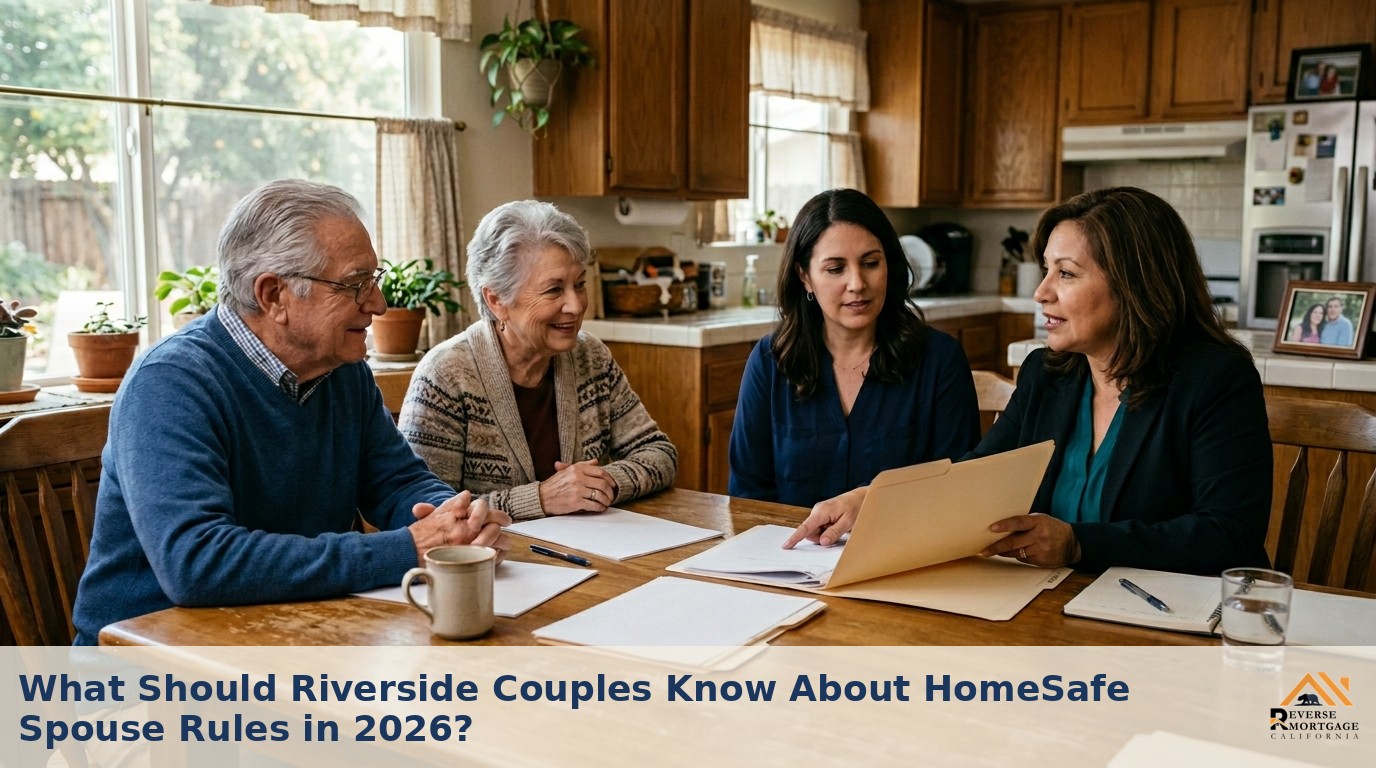
What Should Riverside Couples Know About HomeSafe Spouse Rules in 2026?
Last updated: 2026 | Sources: HomeSafe Underwriting Manual, proprietary program rules, California borrower planning | Author: George Kfoury, NMLS# 365129
When one spouse or co-owner may not be a borrower, the paperwork deserves careful attention before anyone signs. Riverside homeowners often want plain-language steps that fit Inland Empire families, long-held homes, and practical closing timelines. This guide explains HomeSafe spouse and owner protections for Riverside seniors and their families as of 2026.
The facts below are drawn from the cited HomeSafe source material and should be used as a planning framework, not as a personal approval promise. A licensed professional must review the actual borrower, property, title, and product before any final loan decision.
Introduction
California is a community property state, so Riverside couples should understand how HomeSafe looks at title, spouse status, counseling, and maturity-event planning. Seniors and adult children in Riverside often hear broad statements about reverse mortgages, but a HomeSafe file is built from precise underwriting conditions.
This article covers 5 specific questions in spouse protections. Each answer cites the source inline, explains how the rule can show up in a real conversation, and highlights the numbers or document triggers to keep visible.
No blog can replace a full loan review. Use this as a preparation guide so the first appointment is focused, organized, and realistic.
Spouse and owner rules affect both eligibility and family expectations. A person can be important to the home even if they are not the borrower, so title, age, counseling, and documents need to be handled early.
In Riverside, many homes are owned by long-married couples, trusts, or families with title history that changed over time. That makes a careful pre-application review more valuable than a rushed signature package.
These rules are not a substitute for legal advice, but they do show why borrowers should identify every owner and spouse before assuming the loan structure is settled.
1. Which community property states matter for HomeSafe non-borrowing spouse rules?
Answer: HomeSafe identifies Arizona, California, Idaho, Louisiana, Nevada, New Mexico, Texas, Washington, and Wisconsin as community property states.
Source: HomeSafe_Underwriting_Manual.pdf, Non-Borrowing Owners and Non-Borrowing Spouses, page 91, proprietary program, Revised April 2026, current as of 2026.
For planning purposes, treat this as a file documentation requirement. The underwriter still reviews the complete application, but this answer tells you what evidence deserves attention early.
How this looks in practice
A California homeowner considering a proprietary reverse mortgage should verify the exact product, state rules, property value, and underwriting requirements before relying on this rule.
In practice, this rule is a checklist item, not a casual conversation. A borrower can prepare by gathering the relevant statement, asking how the lender will document it, and confirming whether the product being discussed is the same HomeSafe option described in the source.
Key numbers
- 9 states (as of 2026)
- Revised April 2026 (as of 2026)
2. When is a videotaped interview required for a HomeSafe non-borrowing spouse?
Answer: If a HomeSafe property is in a community property state and the non-borrowing spouse has community property rights, a videotaped interview with the borrower, spouse, attorney, court reporter, and notary is required.
Source: HomeSafe_Underwriting_Manual.pdf, Non-Borrowing Owners and Non-Borrowing Spouses, page 91, proprietary program, Revised April 2026, current as of 2026.
For planning purposes, treat this as a file documentation requirement. The underwriter still reviews the complete application, but this answer tells you what evidence deserves attention early.
How this looks in practice
A California homeowner considering a proprietary reverse mortgage should verify the exact product, state rules, property value, and underwriting requirements before relying on this rule.
For a family meeting, the useful step is to turn the rule into a yes-or-no document question. If the file cannot show the required condition, the discussion should shift from optimism to problem solving before appraisal or closing costs build up.
Key numbers
- Revised April 2026 (as of 2026)
3. Can a non-borrowing owner remain on title for HomeSafe?
Answer: A HomeSafe non-borrowing owner may remain on title and is not required to live in the subject property.
Source: HomeSafe_Underwriting_Manual.pdf, Non-Borrowing Owners and Non-Borrowing Spouses, page 90, proprietary program, Revised April 2026, current as of 2026.
For planning purposes, treat this as a file documentation requirement. The underwriter still reviews the complete application, but this answer tells you what evidence deserves attention early.
How this looks in practice
A California homeowner considering a proprietary reverse mortgage should verify the exact product, state rules, property value, and underwriting requirements before relying on this rule.
A local borrower should also separate general reverse mortgage myths from product-specific underwriting. HECM, HomeSafe Standard, HomeSafe Select, and HomeSafe Second can have different details, so one answer from another program may not transfer.
Key numbers
- Revised April 2026 (as of 2026)
4. Does an age-qualified spouse have to be a HomeSafe borrower?
Answer: If a HomeSafe non-borrowing spouse meets the product age requirement, they must be included as a borrower unless an exception applies.
Source: HomeSafe_Underwriting_Manual.pdf, Non-Borrowing Owners and Non-Borrowing Spouses, page 90, proprietary program, Revised April 2026, current as of 2026.
Planning note: Leaving an age-qualified spouse off the loan may require escalation or may be prohibited. A borrower should raise this point before paying for steps that depend on eligibility.
How this looks in practice
A California homeowner considering a proprietary reverse mortgage should verify the exact product, state rules, property value, and underwriting requirements before relying on this rule.
This does not mean every file is approved or denied by one sentence. It means the lender has a defined condition to verify, and a homeowner should know that condition before relying on estimated proceeds or a marketing summary.
Key numbers
- Revised April 2026 (as of 2026)
5. What must a HomeSafe non-borrowing spouse provide?
Answer: A HomeSafe non-borrowing spouse must attend counseling, provide government ID and Social Security card, sign the applicable certification, and provide a handwritten maturity-event plan letter.
Source: HomeSafe_Underwriting_Manual.pdf, Non-Borrowing Owners and Non-Borrowing Spouses, page 90, proprietary program, Revised April 2026, current as of 2026.
For planning purposes, treat this as a file documentation requirement. The underwriter still reviews the complete application, but this answer tells you what evidence deserves attention early.
How this looks in practice
A California homeowner considering a proprietary reverse mortgage should verify the exact product, state rules, property value, and underwriting requirements before relying on this rule.
The safest planning habit is to ask for the rule in writing, compare it with the actual loan structure, and avoid assuming that a past approval on a different mortgage answers the current HomeSafe question.
Key numbers
- Revised April 2026 (as of 2026)
Frequently Asked Questions
Which community property states matter for HomeSafe non-borrowing spouse rules?
HomeSafe identifies Arizona, California, Idaho, Louisiana, Nevada, New Mexico, Texas, Washington, and Wisconsin as community property states. Source: HomeSafe_Underwriting_Manual.pdf, Non-Borrowing Owners and Non-Borrowing Spouses, page 91, proprietary program, Revised April 2026, current as of 2026.
When is a videotaped interview required for a HomeSafe non-borrowing spouse?
If a HomeSafe property is in a community property state and the non-borrowing spouse has community property rights, a videotaped interview with the borrower, spouse, attorney, court reporter, and notary is required. Source: HomeSafe_Underwriting_Manual.pdf, Non-Borrowing Owners and Non-Borrowing Spouses, page 91, proprietary program, Revised April 2026, current as of 2026.
Can a non-borrowing owner remain on title for HomeSafe?
A HomeSafe non-borrowing owner may remain on title and is not required to live in the subject property. Source: HomeSafe_Underwriting_Manual.pdf, Non-Borrowing Owners and Non-Borrowing Spouses, page 90, proprietary program, Revised April 2026, current as of 2026.
Does an age-qualified spouse have to be a HomeSafe borrower?
If a HomeSafe non-borrowing spouse meets the product age requirement, they must be included as a borrower unless an exception applies. Source: HomeSafe_Underwriting_Manual.pdf, Non-Borrowing Owners and Non-Borrowing Spouses, page 90, proprietary program, Revised April 2026, current as of 2026.
What must a HomeSafe non-borrowing spouse provide?
A HomeSafe non-borrowing spouse must attend counseling, provide government ID and Social Security card, sign the applicable certification, and provide a handwritten maturity-event plan letter. Source: HomeSafe_Underwriting_Manual.pdf, Non-Borrowing Owners and Non-Borrowing Spouses, page 90, proprietary program, Revised April 2026, current as of 2026.
About Reverse Mortgage California
Reverse Mortgage California (NMLS# 2530594) is the consumer-facing DBA and brand of O1ne Mortgage Inc. The company helps California seniors understand reverse mortgage choices, including FHA-insured HECM loans and available proprietary programs, with clear education rather than pressure.
Call or text (909) 642-8258 or visit reversemortgagecali.com.
Find us on Google for our location, hours, and directions.
About George Kfoury
George Kfoury (NMLS# 365129) has been licensed in the mortgage industry since 2003 and serves California seniors who want straightforward guidance on reverse mortgage and retirement mortgage options.
He works with homeowners statewide, including Riverside and the Inland Empire. Learn more about George Kfoury, view the Google Business Profile, or call (909) 642-8258.