
Reverse Mortgage California Guide
Which Riverside Property Types May Qualify for HomeSafe in 2026?
Last updated: 2026-10-06 | Source: HomeSafe Underwriting Manual, revised April 2026 | Author: George Kfoury, NMLS# 365129
This Riverside guide addresses property eligibility for homeowners evaluating a proprietary HomeSafe reverse mortgage in 2026.
For Riverside property types, program availability, underwriting results, and individual outcomes vary, so readers should verify current terms before making a financial decision.
Introduction
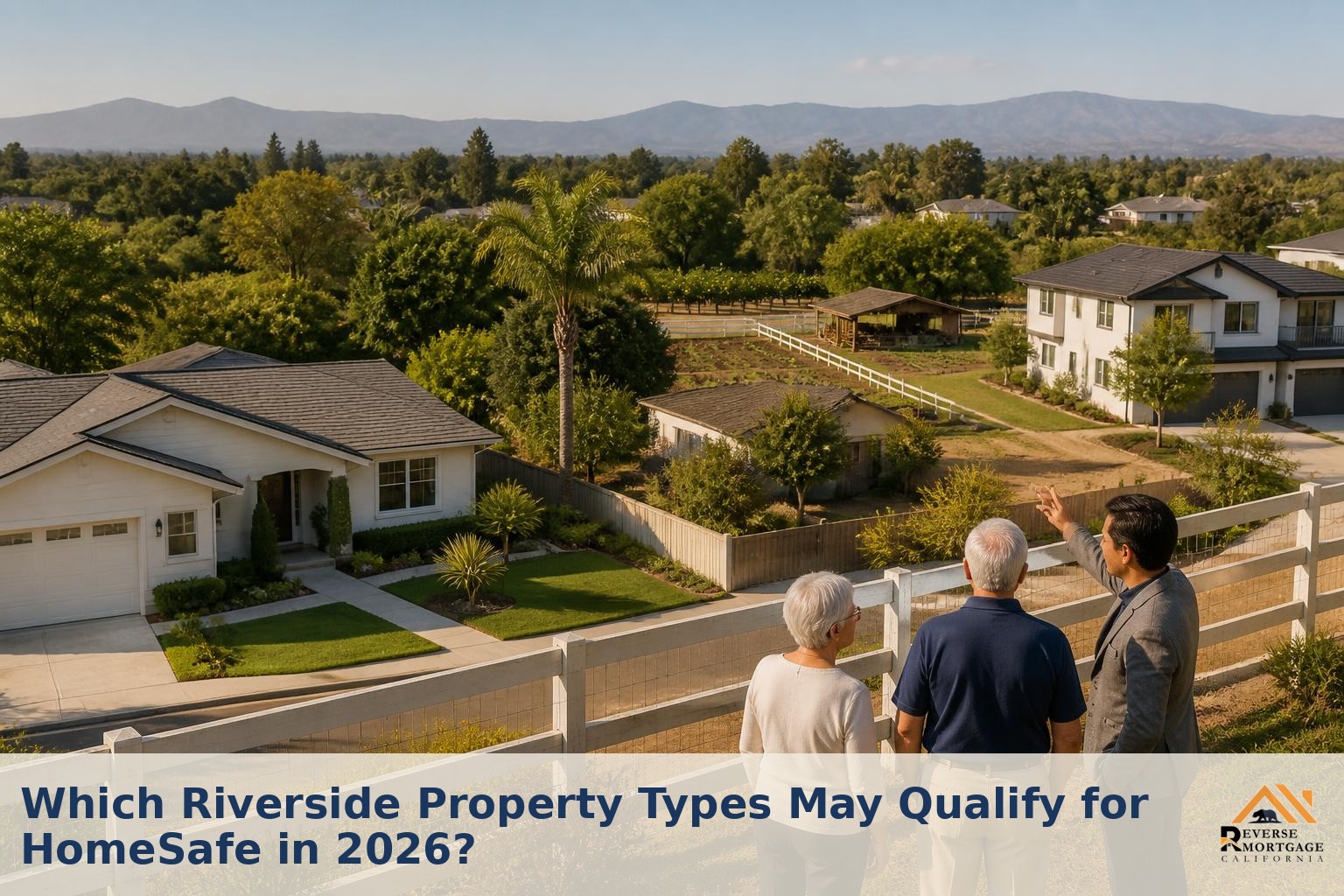
Riverside includes suburban neighborhoods, multi-unit residences, large parcels, and properties with rural characteristics. That variety makes the property-type review a central part of a proprietary reverse mortgage inquiry rather than a box to check after borrower qualification.
This 2026 guide summarizes five rules from the HomeSafe Underwriting Manual. It identifies two generally eligible residential categories and explains why acreage, agricultural zoning, or hobby-farm use can require a different level of scrutiny.
Property acceptability is not determined by a short description alone. Appraisal findings, zoning records, actual use, improvements, marketability, occupancy, and current investor guidance may all affect a final decision, so the examples below are starting points for document preparation.
1. Are properties over 20 acres eligible for HomeSafe?
Answer: Generally no. HomeSafe treats property over 20 acres as ineligible unless a limited escalation is available and approved.
Source for Riverside property types item 1: HomeSafe_Underwriting_Manual.pdf, Property Types, page 38, revised April 2026.
How this looks in practice
Large Riverside County parcels can exceed the standard even when most of the land is unused. The recorded acreage and appraisal description should be checked early, because a residential appearance does not remove the numerical limit.
An escalation is not an entitlement or guaranteed exception. It means the lender may submit a narrowly supported scenario for additional review under then-current guidance, and the result can still be a decline.
Gather the parcel profile, legal description, surveys if available, zoning information, and details of land use. Those records help the reviewer distinguish the residence from any farming, commercial, or surplus-land characteristics.
Key numbers
- 20 acres: general eligibility boundary
- More than 20 acres: limited escalation may be required
2. Can agricultural-zoned property qualify for HomeSafe?
Answer: It is generally ineligible unless documentation proves that the property has no agricultural use.
Source for Riverside property types item 2: HomeSafe_Underwriting_Manual.pdf, Property Types, page 38, revised April 2026.
How this looks in practice
Zoning and actual use are related but distinct. A parcel may retain an agricultural designation even when the owner uses it only as a residence, so the file needs evidence rather than an assumption based on appearance.
Useful records may include a zoning letter, tax assessment, appraisal observations, leases, and information about crops, livestock, or business income. The underwriter decides whether the proof establishes no agricultural use under the current rule.
Owners should disclose all land activity accurately. Minimizing a genuine agricultural operation can create inconsistencies among the application, appraisal, tax returns, insurance, and public records.
Key numbers
- 0 agricultural use: proof needed for the stated exception
- Page 38: source location for property-type guidance
3. Are single-family homes eligible for HomeSafe?
Answer: Yes. Existing single-family residences are listed as eligible HomeSafe property types.
Source for Riverside property types item 3: HomeSafe_Underwriting_Manual.pdf, Property Types, page 38, revised April 2026.
How this looks in practice
A detached Riverside house may fit the basic category, but category eligibility is only one part of the property review. Condition, title, zoning, appraisal, occupancy, insurance, and other program standards remain relevant.
The word 'existing' distinguishes a completed residence from a construction concept or an unfinished project. Repairs or completion items identified during appraisal can affect timing and acceptability even when the building is clearly a single-family home.
Prepare recent mortgage, tax, insurance, and property records before the appraisal process. Consistent information can help resolve questions about additions, accessory spaces, permits, or the way the residence is used.
Key numbers
- 1 primary dwelling category: single-family residence
- Existing construction: the cited eligible type
4. Are duplexes or fourplexes eligible for HomeSafe?
Answer: Yes. Two-to-four-unit properties are listed as eligible property types under the cited HomeSafe rule.
Source for Riverside property types item 4: HomeSafe_Underwriting_Manual.pdf, Property Types, page 38, revised April 2026.
How this looks in practice
A duplex, triplex, or fourplex can enter the property review, but the borrower still needs to meet occupancy and all applicable underwriting requirements. Eligibility of the building category does not convert every rental property into a qualifying principal residence.
Provide unit details, leases, income documents when requested, and evidence showing which unit the homeowner occupies. Legal use and zoning should align with the represented unit count, because an unpermitted conversion can complicate valuation and marketability.
Multi-unit maintenance and insurance may differ from a single-family home. A realistic post-closing budget should account for property charges and repairs even though a reverse mortgage generally does not require monthly principal-and-interest payments.
Key numbers
- 2-4 units: stated eligible range
- More than 4 units: outside this listed category
5. Can a hobby farm qualify for HomeSafe?
Answer: Possibly. A hobby farm may be considered by escalation when it is for personal hobbies and produces no income.
Source for Riverside property types item 5: HomeSafe_Underwriting_Manual.pdf, Property Types, page 38, revised April 2026.
How this looks in practice
A few animals, a personal garden, or recreational land use may look different from an income-producing farm, but the label 'hobby farm' does not settle the question. Actual activity and financial records need to support personal, noncommercial use.
The no-income condition is important. Sales receipts, farm schedules on tax returns, commercial leases, or regular production could conflict with the requested escalation and should be disclosed before review.
Riverside owners can assemble photographs, land-use descriptions, tax records, and zoning evidence for the lender. Approval remains discretionary under current proprietary guidelines, and another loan program may analyze the same property differently.
Key numbers
- $0 farm income: condition stated for hobby treatment
- 1 escalation review: possible, not guaranteed
Frequently Asked Questions
Are properties over 20 acres eligible for HomeSafe?
For Riverside property types FAQ item 1, the cited rule provides this answer: Generally no; HomeSafe treats property over 20 acres as ineligible unless a limited escalation is available and approved; verify the active guideline before relying on item 1. The Riverside property types FAQ source is HomeSafe_Underwriting_Manual.pdf, Property Types, page 38, revised April 2026.
Can agricultural-zoned property qualify for HomeSafe?
For Riverside property types FAQ item 2, the cited rule provides this answer: It is generally ineligible unless documentation proves that the property has no agricultural use; verify the active guideline before relying on item 2. The Riverside property types FAQ source is HomeSafe_Underwriting_Manual.pdf, Property Types, page 38, revised April 2026.
Are single-family homes eligible for HomeSafe?
For Riverside property types FAQ item 3, the cited rule provides this answer: Yes; Existing single-family residences are listed as eligible HomeSafe property types; verify the active guideline before relying on item 3. The Riverside property types FAQ source is HomeSafe_Underwriting_Manual.pdf, Property Types, page 38, revised April 2026.
Are duplexes or fourplexes eligible for HomeSafe?
For Riverside property types FAQ item 4, the cited rule provides this answer: Yes; Two-to-four-unit properties are listed as eligible property types under the cited HomeSafe rule; verify the active guideline before relying on item 4. The Riverside property types FAQ source is HomeSafe_Underwriting_Manual.pdf, Property Types, page 38, revised April 2026.
Can a hobby farm qualify for HomeSafe?
For Riverside property types FAQ item 5, the cited rule provides this answer: Possibly; A hobby farm may be considered by escalation when it is for personal hobbies and produces no income; verify the active guideline before relying on item 5. The Riverside property types FAQ source is HomeSafe_Underwriting_Manual.pdf, Property Types, page 38, revised April 2026.
About Reverse Mortgage California
In this Riverside property types guide, Reverse Mortgage California (NMLS# 2530594) is identified as the consumer-facing DBA and brand of O1ne Mortgage Inc. Its role in the Riverside property types article is to provide educational context for California homeowners comparing reverse mortgages and related retirement-mortgage choices.
For help discussing Riverside property types, Call or text (909) 642-8258 or visit reversemortgagecali.com.
Find us on Google for our location, hours, and directions.
About George Kfoury
For this Riverside property types topic, George Kfoury (NMLS# 365129) is a mortgage professional licensed since 2003 who serves California seniors with plain-language information about reverse mortgage and retirement mortgage options.
He brings statewide experience and Riverside context to questions about property eligibility without promising approval or proceeds. Learn more about George Kfoury.