Reverse Mortgage California Spouse Guide
What Should Los Angeles Couples Know About HomeSafe Non-Borrowing Spouse Rules in 2026?
Last updated: 2026 | Source: HomeSafe Underwriting Manual, revised April 2026 | Author: George Kfoury, NMLS# 365129
A spouse or co-owner who will not sign the note can still have a major role in a HomeSafe proprietary reverse mortgage. In California, community property rights add documentation and interview requirements that Los Angeles couples should understand before processing begins.
This guide explains who may remain on title, when an age-qualified spouse generally must join as a borrower, what a non-borrowing spouse provides, and why a videotaped interview may be required. These are program rules, not individualized legal advice.
Introduction
The words non-borrowing spouse and non-borrowing owner describe participation in the loan, not an absence of legal interests or responsibilities. Title, marital rights, occupancy, age, counseling, and the plan after a maturity event can all affect the file. Couples should avoid assuming that leaving one person off the note removes that person from the process.
HomeSafe is proprietary and differs from an FHA-insured HECM. Protections and obligations should not be treated as interchangeable between products. A borrower and spouse should ask what happens after death, permanent move-out, sale, default, or another maturity event, then consider independent legal and financial guidance.
The following five points come from the HomeSafe Underwriting Manual revised April 2026. They describe baseline requirements, while exceptions and final eligibility depend on current guidelines and the facts documented in the application.
1. Which community property states are identified by HomeSafe?
Answer: HomeSafe lists Arizona, California, Idaho, Louisiana, Nevada, New Mexico, Texas, Washington, and Wisconsin as community property states.
Source: HomeSafe_Underwriting_Manual.pdf, Non-Borrowing Owners and Non-Borrowing Spouses, page 91, revised April 2026
How this looks in practice
California’s inclusion means a Los Angeles application cannot be evaluated as though marital property rights were irrelevant. The lending team needs an accurate marital-status disclosure and must determine whether a spouse has community property rights in the home, even when only one person expects to borrow.
The list contains states with different statutes, forms, and procedures, so being on the list does not make every state’s treatment identical. For a California home, the file must satisfy the current HomeSafe requirements and applicable California law. Legal questions about ownership should be directed to qualified counsel.
Key numbers
- 9 states: identified in the manual
- Page 91: community property guidance
The nine named jurisdictions are Arizona, California, Idaho, Louisiana, Nevada, New Mexico, Texas, Washington, and Wisconsin. Location is a screening point; the borrower’s actual marital and title circumstances still require review.
2. When is a videotaped interview required for a HomeSafe non-borrowing spouse?
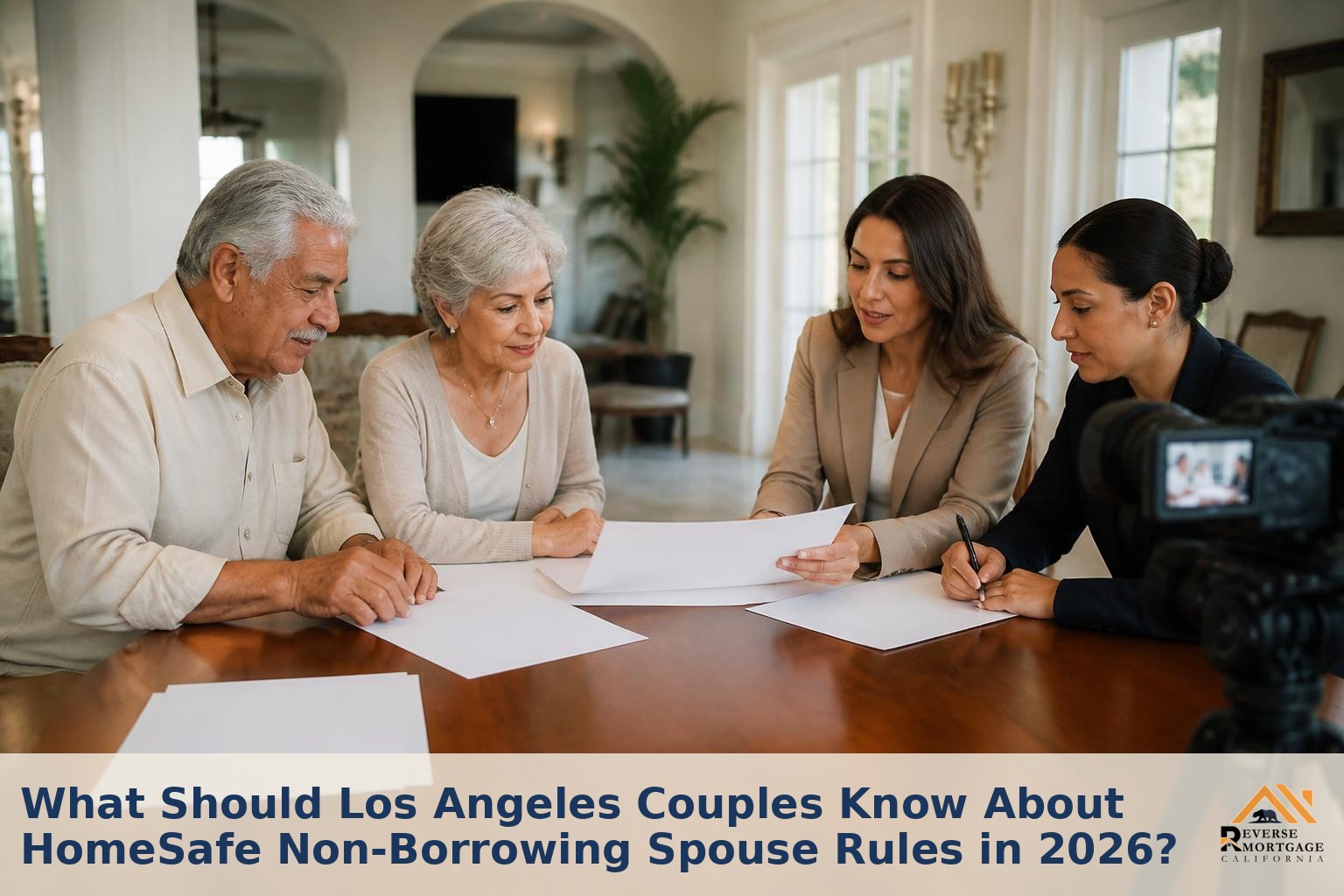
Answer: When the property is in a community property state and the non-borrowing spouse has community property rights, HomeSafe requires a videotaped interview involving the borrower, spouse, attorney, court reporter, and notary.
Source: HomeSafe_Underwriting_Manual.pdf, Non-Borrowing Owners and Non-Borrowing Spouses, page 91, revised April 2026
How this looks in practice
For a qualifying Los Angeles file, this is more formal than a routine lender phone call. The required participants must be coordinated, and the record is intended to document informed participation. Scheduling should begin early because arranging an attorney, court reporter, notary, borrower, and spouse at one time may take planning.
The interview does not replace counseling or the rest of the loan documents. It addresses a specific community property circumstance under this proprietary program. Borrowers should confirm the approved procedure and required content with the lender instead of recording an informal conversation on their own.
Key numbers
- 5 participant roles: borrower, spouse, attorney, court reporter, notary
- 1 videotaped interview: when the rule applies
Five roles are expressly named, although one professional might not necessarily satisfy multiple roles unless the lender permits it. The current closing team should confirm attendance, format, and retention requirements.
3. Can a non-borrowing owner remain on title with HomeSafe?
Answer: Yes. A HomeSafe non-borrowing owner may stay on title and is not required by this rule to occupy the subject property.
Source: HomeSafe_Underwriting_Manual.pdf, Non-Borrowing Owners and Non-Borrowing Spouses, page 90, revised April 2026
How this looks in practice
Imagine an adult child who shares title to a parent’s Los Angeles residence but lives elsewhere. The cited rule permits a non-borrowing owner to remain vested without making that co-owner occupy the home. That does not automatically resolve every underwriting, title, counseling, or estate-planning question.
Remaining on title is also different from becoming obligated as a borrower. Each person should understand which papers they will sign, what rights continue, and how a maturity event could affect the property. The family may want separate legal advice when ownership is shared or succession plans are complex.
Key numbers
- 0 occupancy requirement: for the non-borrowing owner under this rule
- Page 90: title guidance
The rule creates no residence requirement for the non-borrowing owner, but the borrowing homeowner and property must satisfy all applicable occupancy and program conditions. It should not be read as a general waiver for every party.
4. Must an age-qualified spouse be included as a HomeSafe borrower?
Answer: Generally yes. A non-borrowing spouse who meets the HomeSafe age requirement must be included as a borrower unless an applicable exception is accepted.
Source: HomeSafe_Underwriting_Manual.pdf, Non-Borrowing Owners and Non-Borrowing Spouses, page 90, revised April 2026
How this looks in practice
A couple cannot necessarily choose borrower status solely to simplify paperwork or increase estimated proceeds. If both spouses satisfy the product’s age criterion, the guideline expects both to participate as borrowers unless the file fits an authorized exception. The lender must evaluate any proposed exception before the couple relies on it.
Including another borrower can affect disclosures, counseling, signatures, underwriting, and the loan calculation. It can also shape how both spouses experience the loan after closing. Estimates should therefore use accurate ages and ownership information from the start rather than being built around an assumed exclusion.
Key numbers
- 2 spouses: typically included when both are age-qualified
- Page 90: age-qualified spouse rule
The evidence fact does not state one universal qualifying age because HomeSafe product versions may differ. Confirm the age threshold for the exact program and application date before drawing conclusions.
5. What documents and steps does a HomeSafe non-borrowing spouse need?
Answer: The spouse must attend counseling, provide government identification and a Social Security card, sign the applicable certification, and submit a handwritten letter explaining the plan for a maturity event.
Source: HomeSafe_Underwriting_Manual.pdf, Non-Borrowing Owners and Non-Borrowing Spouses, page 90, revised April 2026
How this looks in practice
The maturity-event letter deserves thoughtful attention. It should reflect the spouse’s own realistic plan if the loan becomes due, such as selling, refinancing if eligible, or using other resources. A handwritten statement should not be treated as a scripted promise supplied by someone who has not discussed the consequences.
Government ID and Social Security documentation help establish identity, while counseling and certification document informed involvement. Completing one item does not substitute for the others. A checklist from the loan team can keep the Los Angeles household from discovering an omitted requirement near closing.
Key numbers
- 4 requirement groups: counseling, identity documents, certification, handwritten plan
- Page 90: documentation list
The identity group includes both government-issued ID and the Social Security card. Additional records may be requested for the particular file, so this four-part summary is a starting checklist rather than an exhaustive closing package.
Frequently Asked Questions
Which community property states are identified by HomeSafe?
The manual identifies nine community property states: Arizona, California, Idaho, Louisiana, Nevada, New Mexico, Texas, Washington, and Wisconsin.
When is a videotaped interview required for a HomeSafe non-borrowing spouse?
The videotaped interview applies when a community property state’s rules give the non-borrowing spouse community property rights; the specified participants include both spouses and three professionals.
Can a non-borrowing owner remain on title with HomeSafe?
A non-borrowing owner can remain on title and does not have to live in the home under the cited HomeSafe provision, subject to the rest of the file requirements.
Must an age-qualified spouse be included as a HomeSafe borrower?
HomeSafe generally requires a spouse who meets the applicable product age requirement to be a borrower unless the lender approves a guideline exception.
What documents and steps does a HomeSafe non-borrowing spouse need?
The non-borrowing spouse must complete counseling and provide identity records, a signed certification, and a handwritten maturity-event plan letter under the current guideline.
About Reverse Mortgage California
Reverse Mortgage California (NMLS# 2530594), the consumer-facing DBA and brand of O1ne Mortgage Inc., provides clear education for older California homeowners and their families. The company explains HECM and proprietary choices without treating general guidelines as personal legal advice or a lending commitment.
Call or text (909) 642-8258 or visit reversemortgagecali.com.
Find us on Google for our location, hours, and directions.
About George Kfoury
Licensed in the mortgage industry since 2003, George Kfoury (NMLS# 365129) serves California seniors and families evaluating retirement mortgage options. His approach emphasizes plain explanations of spouse participation, documents, and product differences.
His statewide service includes Los Angeles households sorting through ownership, counseling, and non-borrowing spouse considerations; readers can learn more about George Kfoury or call (909) 642-8258.